Every weekly educational post is collected here. Choose a topic, then go beyond the infographic with a clear deep dive. A new topic can be added every week as the Instagram series grows.
Educational series · Weeks 2–18
Choose a topic.
Week 1 was the return post; the educational series begins with Week 2. Select any topic artwork to open its dedicated deep dive.
Choose a topic above to open its deep dive. The article will appear here, with the rest kept out of the way.
Week 18 · Recognition & liquidity
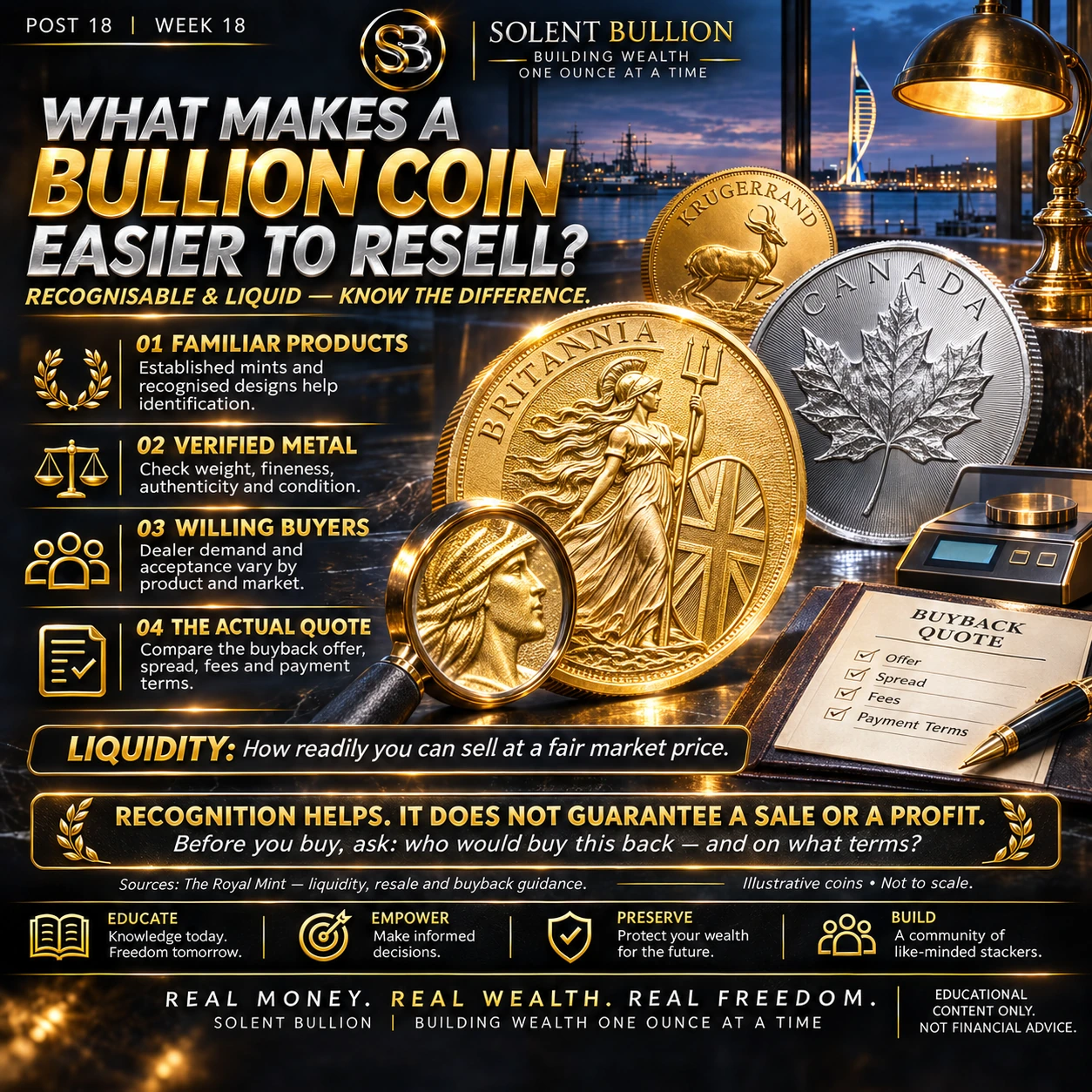
What Makes a Bullion Coin Easier to Resell?
Week 18 education · 15 November 2026 · Companion to our social post.
You recognise the design, know the mint and can name the coin. Does that mean it will be easy to sell? Familiarity is helpful, but it leaves several questions unanswered: is this particular coin genuine, does a buyer want it, what will they pay, and when will you receive the money?
The key point: A recognisable coin is easier to identify. Liquidity also depends on verification, willing buyers and workable sale terms. Neither familiarity nor liquidity guarantees a profit.
What does “liquid” mean for physical bullion?
Liquidity describes how readily an asset can be sold at a fair market price. For physical coins, think about the whole route from ownership to available funds. Finding a buyer is one step; agreeing a price, completing checks and receiving payment are others. The Royal Mint’s risk guide highlights buyer availability, authenticity and premiums or discounts as practical considerations.
A listing that attracts attention is not the same as a completed sale. Equally, an immediate offer at a very steep discount tells you little about whether you could readily sell at a fair price. Speed, price and certainty all belong in the conversation.
1. Familiar products make identification more straightforward
Established coin series have published specifications and designs that buyers may already know. The Royal Mint’s bullion glossary describes standard, regularly produced core products as typically liquid. That is useful context, rather than a promise about every coin or every transaction.
Record the exact product: issuer, series, year, metal, size and stated fine-metal content. “Gold coin” is a starting description, not enough information for a meaningful comparison. Familiar names can reduce the explanation needed, but the buyer still needs to identify and assess the actual item.
2. Recognition does not establish authenticity
A familiar design, mint name or fineness stamp is a claim about the product. Verification establishes whether the item matches that claim. Keep purchase records and check the appropriate official specifications; a picture or magnifying glass alone cannot establish authenticity.
Security features also vary between products and years. For example, the Royal Canadian Mint’s Bullion DNA system supports authentication of Gold Maple Leaf coins dated 2014 onwards and Silver Maple Leaf coins dated 2015 onwards through authorised dealers using specialist equipment and its registered security-mark database. This is a specific system for eligible coins, not a test available from looking at any maple-leaf image.
The practical question is: what checks will the proposed buyer carry out, and could those checks change the offer? Do not damage a coin with improvised testing. If authenticity is uncertain, use a reputable professional with appropriate methods.
3. There must be a willing buyer for that product
Do not assume the original seller is your only resale route, or that every dealer accepts the same products. The Royal Mint’s buyback service, for example, accepts qualifying bullion from other mints, including Krugerrands, Philharmonics and Maple Leafs. It also sets metal and purity criteria. This illustrates why checking a buyer’s actual acceptance policy is more useful than assuming a recognisable name will always qualify.
Ask about the exact coin and quantity you own. A dealer’s willingness to quote today is evidence about today’s route to market; it is not a commitment to buy in every future market. Keep more than one credible route in mind and revisit the terms when you actually intend to sell.
4. Condition and packaging need context
Separate the precious metal from any additional value a buyer places on presentation or collectability. A bullion offer and a collector’s offer may assess the same item differently. Ask how condition, capsules, certificates or missing packaging affect the quote for your particular product.
Packaging is not a universal resale rule. In its sealed-bar FAQ, The Royal Mint says removing a bar’s packaging does not change its intrinsic metal value or reduce its own buyback price, while packaging may reassure private buyers. That is one provider’s guidance about bars: it does not prove that every buyer treats every coin the same way. Retain useful records and packaging, but do not treat either as proof that the contents are genuine.
5. Compare the amount you would actually receive
A dealer’s advertised selling price is the price a customer pays to buy. A buyback offer is what the dealer offers the seller. The gap between buying and selling prices is commonly called the spread; see Week 7: Bullion premiums for the relationship between metal value and the retail price.
Read the quote alongside its conditions. The Royal Mint’s sale terms distinguish an indicative valuation from the outcome after assessment, and put postage and insurance costs on the seller. Other buyers may operate differently. Check when the price is fixed, what deductions apply, who covers transit and when funds become available.
A useful comparison: Net sale proceeds = the accepted buyback amount minus any selling costs you must pay. Compare like-for-like quotes at the same time, for the same verified product and quantity.
A worked example: familiarity does not recover every premium
Hypothetical illustration only — these are not live prices, dealer quotes or a forecast. Imagine two different coins, each verified to contain one troy ounce of fine gold. For this example only, both attract the same £3,000 buyback offer at the comparison time, and selling either costs £20.
Coin A: total purchase cost £3,150. Net sale proceeds: £3,000 − £20 = £2,980. Difference from purchase cost: £170.
Coin B: total purchase cost £3,300. Net sale proceeds: £3,000 − £20 = £2,980. Difference from purchase cost: £320.
In this deliberately simplified comparison, paying £150 more did not produce a higher resale offer. Both coins could be recognisable and readily accepted, yet the purchase-to-sale difference is different. In a real transaction, market prices, product premiums, condition, quotes and costs can change. This arithmetic demonstrates the importance of the actual offer; it does not predict either coin’s future return.
Five questions for a more useful bullion checklist
What exactly is it? Note the issuer, series, year, size, fineness and fine-metal content.
Who will consider buying it? Check acceptance for that exact product, quantity and condition.
What must be verified? Ask about inspection, documents and any effect on the provisional offer.
What is the net amount? Include any fees, postage and suitable insurance; establish when the quote is fixed.
When is payment available? Understand the steps between delivery, acceptance and usable funds.
Three common questions
Does a recognised coin guarantee an instant sale? No. Recognition helps identification; buyer availability, checks and settlement still matter.
Does higher purity automatically mean greater liquidity? No. Purity describes metal composition. It does not establish demand or a buyer’s terms. Compare fine-metal content accurately and revisit Week 14: Purity and fineness.
Will every dealer offer the same price? Do not assume so. Obtain comparable current quotes and check their conditions. A higher headline offer can leave you with less after costs.
The stacker takeaway: Before buying, ask: “Who would buy this back — and on what terms?” A useful answer includes the product, checks, net quote and payment process. Familiarity is one part of that answer.
Sources and further reading
Primary-source guidance checked 15 November 2026. Provider policies can change; consult the current terms before arranging a sale. Examples of mint services explain the process and are not endorsements or promises of acceptance.
Educational content only — not financial advice. Bullion prices can fall as well as rise. The artwork is illustrative, not an authentication reference.
Week 17 education · Companion to our Instagram and Facebook post.
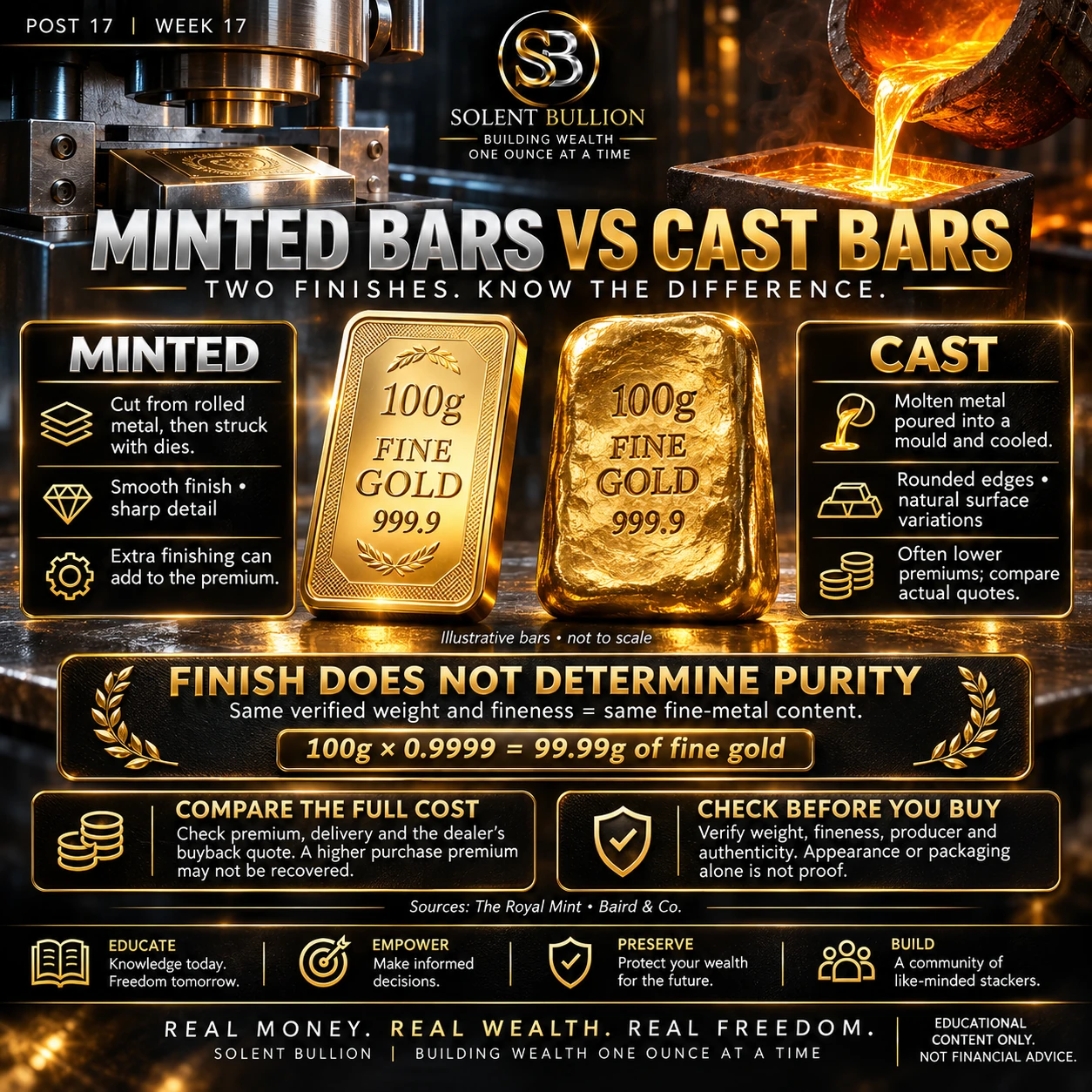
Put a minted gold bar beside a cast one and the difference is easy to see. One might have sharp lettering and a polished finish; the other might have rounded edges and ripples from cooling. If they contain the same amount of fine gold, what are you paying for when one costs more?
The key point: Minted and cast describe how a bar was made. Check the metal, weight and fineness to establish what it contains. Compare the purchase cost and buyback terms to see what the finish will cost you.
From press to pour: how each bar gets its shape
Minted bars: Metal is typically rolled to an even thickness, then blanks are cut and struck with dies. The process gives a consistent shape and can produce detailed designs and crisp edges. Some minted bars come sealed in an assay card showing product details; check the individual listing.
Cast bars: Molten metal is poured into a mould and allowed to cool. Rounded corners and surface variations are common, and the producer may stamp the bar with its weight, fineness and other identifying marks. Those surface variations can be normal for a cast bar. They do not establish whether an individual bar is genuine.
Both methods are used for gold and silver. Weight, finish, serial numbering and packaging vary by product. Check the specification before drawing conclusions from the format.
Two finishes, the same amount of gold
Suppose each of the bars pictured has a total weight of exactly 100g and a fineness of 999.9 parts per thousand. Multiply 100g by 999.9 ÷ 1,000 and you get 99.99g of fine gold per bar. Their different finishes do not change that calculation. Check whether a listing quotes total weight or fine-metal weight before doing the maths; if it already gives fine weight, do not apply the purity conversion again.
What does the extra premium get you?
Minting, decorative details and packaging can add to the price. Producer, availability and dealer pricing matter too, so cast is not always cheaper. Compare bars of the same metal and fine weight at the same time. Include delivery, fees and any applicable tax when working out the amount you would actually pay.
Illustrative example, not market prices: Two bars contain the same amount of fine gold, with an assumed metal value of £8,000. The cast bar costs £8,160 and the minted bar £8,280, including delivery. That puts the cast bar 2% above the reference value and the minted bar 3.5% above it.
If a dealer quoted £7,920 to buy back either bar at that same moment, the gap between buying and selling would be £240 for cast and £360 for minted. In this example the minted finish adds £120 to the purchase cost and nothing to the buyback quote. Real quotes can differ by producer, condition, packaging and dealer, and they change as the market moves.
A quick checklist before comparing two listings
Match the metal and fine weight. Divide the total price by the fine grams to compare different sizes on the same basis.
Check who made it and who is selling it. Look for a clear product specification, a documented purchase and a seller you can verify.
Treat packaging and stamps as clues. Neither is proof of authenticity. If you have doubts, ask a reputable bullion specialist about appropriate verification.
Ask about resale. Find out what the dealer accepts, how the quote is set, and whether broken seals, missing paperwork or testing affect the offer.
Stacker takeaway: If you prefer the design or presentation of a minted bar, work out exactly how much extra you are paying for it. If your priority is the amount of metal, compare the cost per fine gram and the buyback quote side by side.
Published · Companion to our Week 16 Instagram and Facebook education post.
The Sovereign brings two subjects together: the history of British coinage and the practical arithmetic of owning gold. Its familiar name can make a listing feel straightforward. Before comparing prices, however, establish which size, edition and amount of fine gold the seller is describing.
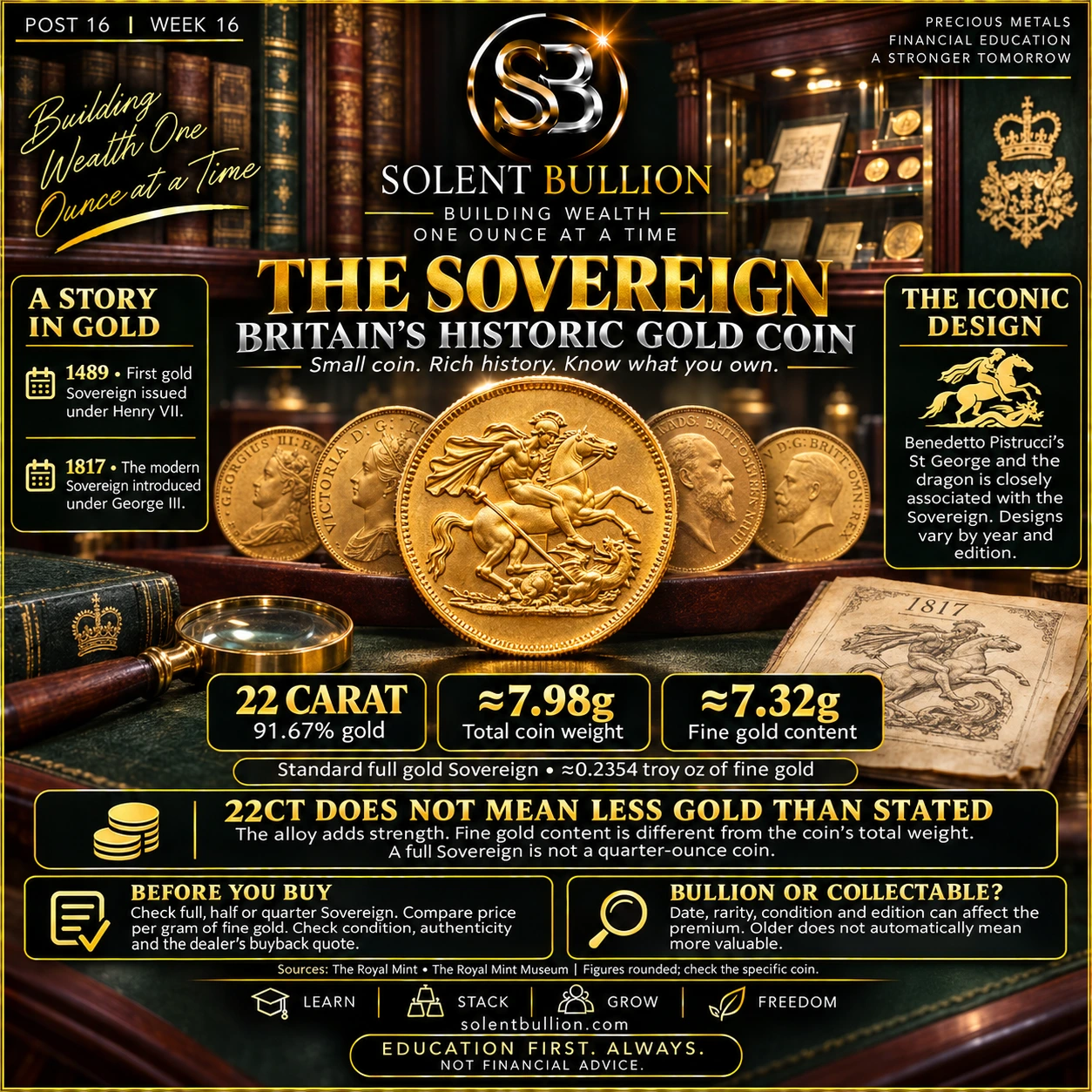
The starting point: A standard full gold Sovereign is a 22-carat coin containing approximately 7.32g of fine gold. It is neither a one-ounce coin nor a quarter-ounce coin. Understanding that distinction makes the rest of the comparison much easier.
Two dates explain the name
The first gold Sovereign was issued under Henry VII in 1489. The modern Sovereign arrived in 1817 under George III. These are separate milestones: the modern coin revived an older name, rather than simply continuing an unchanged Tudor specification.
Benedetto Pistrucci’s St George and the dragon became closely associated with the modern Sovereign. The Royal Mint Museum traces its later life as both a bullion coin and a Proof collectable. A coin’s design can vary with its year and edition; the familiar scene is not a universal identification rule.
Read the specification in three parts
Standard full gold Sovereign — approximate figures
Measure
What it tells you
22 carat / about 91.67% gold
The proportion of gold in the alloy.
About 7.98g total weight
The whole coin, including its alloying metals.
About 7.32g fine gold
The gold component, approximately 0.2354 troy ounces.
22.05mm diameter
A published size specification, not proof of authenticity.
These rounded figures describe a standard full gold Sovereign. Check the exact product specification and the actual item, particularly for older coins. Do not expect multiplying rounded weight and purity figures to reproduce an independently rounded fine-weight figure perfectly.
For your records, keep separate fields for gross weight and fine-metal weight. If a listing already states the fine gold content, do not apply the purity percentage to that figure again. That would count the purity adjustment twice. Revisit Week 14: Purity and fineness if that distinction is unfamiliar.
Why a Sovereign is not a quarter ounce
Compare approximately 0.2354 fine troy ounces with 0.25 fine troy ounces. The difference is approximately 0.0146 troy ounces. Relative to a quarter ounce, that is about 5.8% less fine gold. It is a difference in quantity, not a judgement about which product is better.
For example, suppose a full Sovereign and a quarter-ounce fine-gold coin each cost £800. Dividing £800 by 0.2354 gives roughly £3,398 per fine troy ounce for the Sovereign. Dividing £800 by 0.25 gives £3,200 per fine troy ounce for the quarter-ounce coin. Equal purchase prices do not establish equal metal value.
This is an invented comparison, not a current quote. It ignores differences in edition, condition and purchase terms. Its purpose is to show why normalising the fine-metal quantity matters. The name “Quarter-Sovereign” also means a different size in the Sovereign family, not a quarter-ounce coin.
Separate metal value from the full price
A basic estimate begins with fine troy ounces multiplied by the gold reference price per troy ounce. The Royal Mint explains that purchase prices normally include a premium, and that some coins attract additional collector interest.
Here is a second hypothetical example. Assume gold is £3,000 per troy ounce and use 0.2354 troy ounces for the full Sovereign. Its approximate gold value is £706.20. At an assumed purchase price of £760, the difference is £53.80, approximately 7.6% above that metal value. Neither figure is today’s market price.
Use the actual fine content and a consistent price snapshot when comparing real products. Then add delivery and any other applicable charges. A headline premium and a final delivered cost answer different questions.
Bullion interest and collector interest
Ask what you are paying for. One listing may emphasise gold content; another may price a particular date, condition or edition for collectors. The Royal Mint identifies rarity and historical significance among the factors that can affect a Sovereign’s value above its metal content. Age alone does not establish a higher resale price.
A useful personal check is to finish this sentence before buying: “I am choosing this particular coin because…” If the answer is its design or historical interest, record that alongside the cost. If the answer is its gold content, make sure your comparison uses fine gold rather than the total coin weight.
Keep the purchase price separate from any buyback indication. Ask what a dealer would currently offer for the same item and on what terms. Do not build a plan around recovering every pound of an original premium.
A six-point buying checklist
Identify the item: full, half or quarter Sovereign; year and edition; bullion or collector presentation.
Record the metal: confirm purity and fine gold content from an appropriate specification.
Compare equal units: calculate total purchase cost per fine gram or fine troy ounce.
Understand condition and provenance: ask the seller how the item is described and verified. Appearance or a familiar design alone does not establish authenticity.
Look at the exit: obtain a buyback indication and check any conditions, deductions or delivery costs.
Keep evidence: retain the invoice, description, fine weight and full amount paid in your private inventory.
Check your understanding
Does 7.98g mean 7.98g of pure gold? No. It is the approximate total coin weight; fine gold content is about 7.32g.
Is a full Sovereign exactly one quarter ounce of gold? No. Its approximate fine content is 0.2354 troy ounces.
Does an old date guarantee a valuable collectable? No. Assess the particular item, its condition and evidence of collector demand rather than age alone.
The stacker takeaway: Appreciate the history, but compare the numbers. Identify the exact coin, understand its fine gold content and look at both purchase and potential sale terms. A famous name is a starting point for research.
Sources checked 4 November 2026. Calculations, scenarios and checklist are original Solent Bullion educational examples. Figures are rounded. Artwork is illustrative, not an authentication reference.
Educational content only—not financial advice or a recommendation to buy. Precious-metal prices can fall as well as rise, and purchase premiums and other costs may not be recovered.
Fractional Bullion: Smaller Pieces, Different Trade-Offs
Published · Companion to our Week 15 educational post.
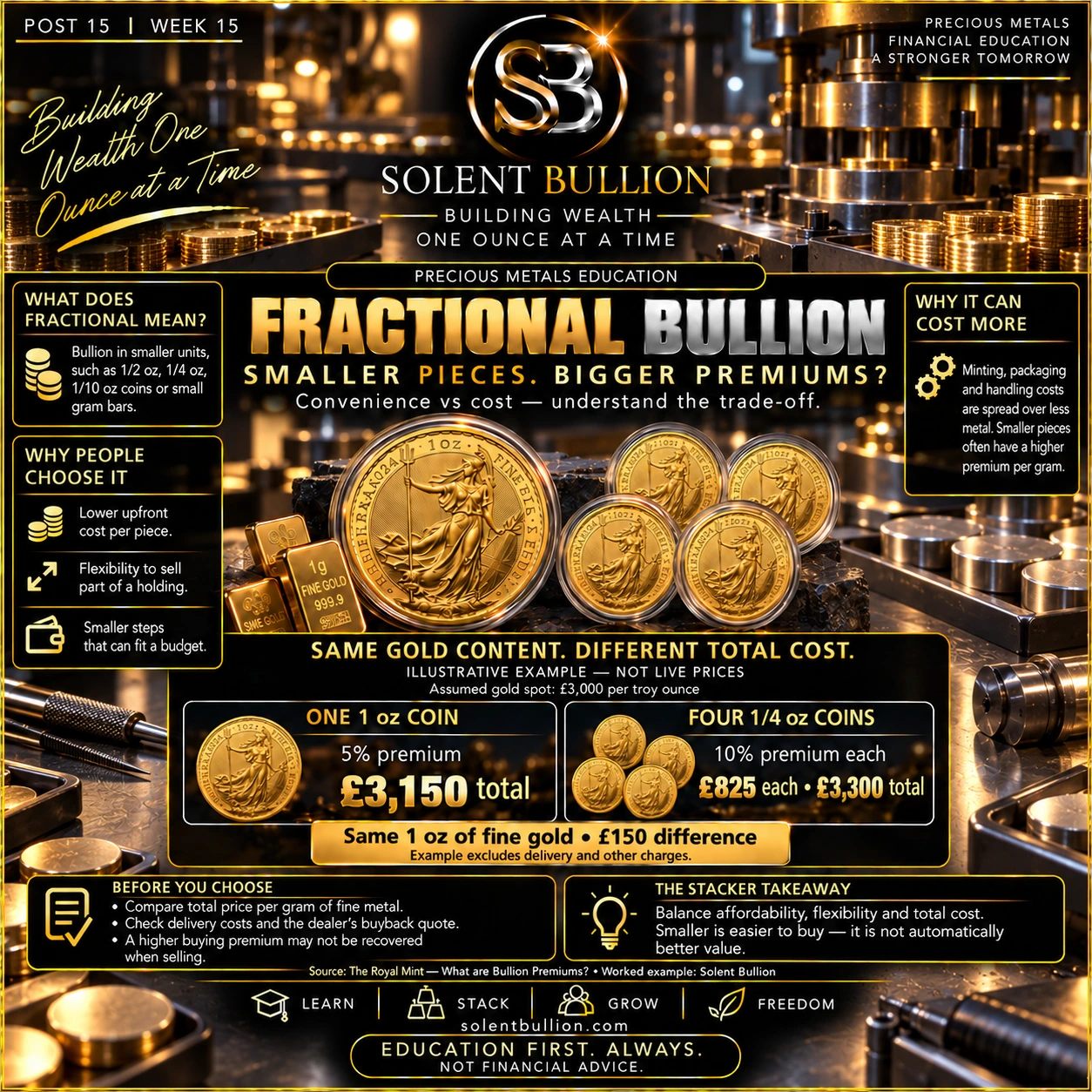
A lower price on the product page does not necessarily mean a lower price for the metal inside it. A quarter-ounce gold coin costs less to buy than a one-ounce coin, but four quarter-ounce coins can cost more than the larger coin. Week 15 explores that difference: the flexibility of smaller pieces alongside the extra cost you may pay for them.
The idea to remember: Compare equal amounts of fine metal, then decide what the flexibility of smaller units is worth to you. Affordable upfront and economical per ounce are different measures.
What does fractional bullion mean?
Fractional coins contain a fraction of a troy ounce of precious metal: common descriptions include half-ounce, quarter-ounce and tenth-ounce. Small gram-denominated bars offer another way to buy smaller quantities. Read the maker’s specification for fine-metal content rather than assuming every product’s gross weight equals its pure-metal weight.
A one-troy-ounce fine-gold holding can therefore be divided into two half-ounce coins, four quarter-ounce coins or ten tenth-ounce coins. The total gold can be the same even though the number of items, packaging and purchase cost differ.
Why can the premium be higher?
The premium is the amount charged above the metal’s spot-based value. The Royal Mint explains that production, protective packaging and business costs contribute to premiums, and that larger products are generally cheaper per ounce to produce than smaller ones. A smaller coin still needs manufacturing and handling, with those costs spread across less metal. Supply and demand can also change the premium. This is a tendency, not a fixed price rule: compare actual quotes.
One ounce versus four quarters: follow the numbers
Illustrative calculation only—not current market prices, dealer offers or typical premium estimates. Assume a gold spot price of £3,000 per troy ounce. The two assumed premiums below are deliberately different to show the effect of size. Delivery and other charges are excluded.
Purchase
Fine gold
Assumed premium
Total price
One 1 oz coin
1 troy oz
5%
£3,150
Four ¼ oz coins
1 troy oz altogether
10% on each coin
£825 each; £3,300 total
The quarter-ounce metal value is £750. Adding 10% gives £825; multiplying by four gives £3,300. For the larger coin, £3,000 plus 5% gives £3,150. The difference is £150 for the same one troy ounce of fine gold. That extra £150 buys the smaller units in this example, not additional gold.
Expressed per fine gram, the totals are approximately £101.27 and £106.10 respectively, using 31.1035 grams per troy ounce. Keeping the denominator consistent makes the comparison clearer.
What does the flexibility actually give you?
Imagine someone holding a single one-ounce coin who later wishes to sell only a quarter ounce. Selling that coin means disposing of the whole item. Someone holding four separate quarter-ounce coins could instead seek a quote for one coin and retain the other three. That is divisibility, rather than a promise that smaller coins will sell faster or at a better price.
Smaller items can also fit a smaller purchase budget. Compare the trade-off explicitly: buying smaller units now may carry a higher unit cost; saving for a larger item involves waiting and facing whatever market price applies later. Neither route guarantees a better result. Essential spending and accessible cash reserves still matter.
The purchase premium is not your future sale price
Keep a second comparison alongside the buying price: a realistic dealer buyback quote for the same product. Do not assume a future buyer will reimburse the original premium. A smaller unit’s convenience can have value to its owner without producing a resale profit.
For a simple illustration, an item bought for £825 and later sold for £760 has a £65 difference before any other costs. This hypothetical example is arithmetic, not a forecast. Changes in the metal price and the actual sale terms will affect the outcome.
A practical comparison checklist
Match the metal: compare gold with gold, using verified fine-metal content.
Normalise the price: total purchase cost divided by fine grams gives cost per fine gram.
Include the full bill: account for delivery and any applicable charges rather than relying on the headline item price.
Check the exit: request a buyback quote and understand any conditions or fees.
Explain the choice: identify whether the smaller unit solves a real budget or partial-sale need.
Keep records: note product, fine weight, date and total amount paid.
Check your understanding
Do four quarter-ounce coins contain more gold than one one-ounce coin? No, assuming those descriptions state fine-gold content. Both total one troy ounce.
Does a lower item price prove better value per ounce? No. Divide by fine-metal content before comparing.
Are the example premiums a guide to today’s market? No. They are teaching assumptions; obtain current, like-for-like quotes.
The stacker takeaway: Smaller pieces can make ownership more manageable and allow partial sales. Larger pieces may offer a lower cost per ounce. Make the trade-off visible before choosing, rather than treating either size as automatically best.
Sources and further learning
The Royal Mint — What are Bullion Premiums? supports the explanation of manufacturing costs and premium calculation. Checked 25 October 2026. Worked examples, scenarios and comparison checklist are Solent Bullion educational illustrations.
Educational content only—not financial advice or a recommendation to buy. Precious-metal prices can fall as well as rise. Purchase premiums and other costs may not be recovered.
Purity & Fineness: 999, 999.9 and 24 Carat Explained
Published · Companion to our Week 14 Instagram and Facebook post.
A gold bar marked 999.9, a silver coin marked 999 and a 22-carat Sovereign describe their precious-metal content in different ways. Reading those descriptions together with the product’s weight helps you understand what the item contains. Purity is one useful specification; it does not establish authenticity or tell you everything about a product’s price.
Purity and fineness describe the same proportion
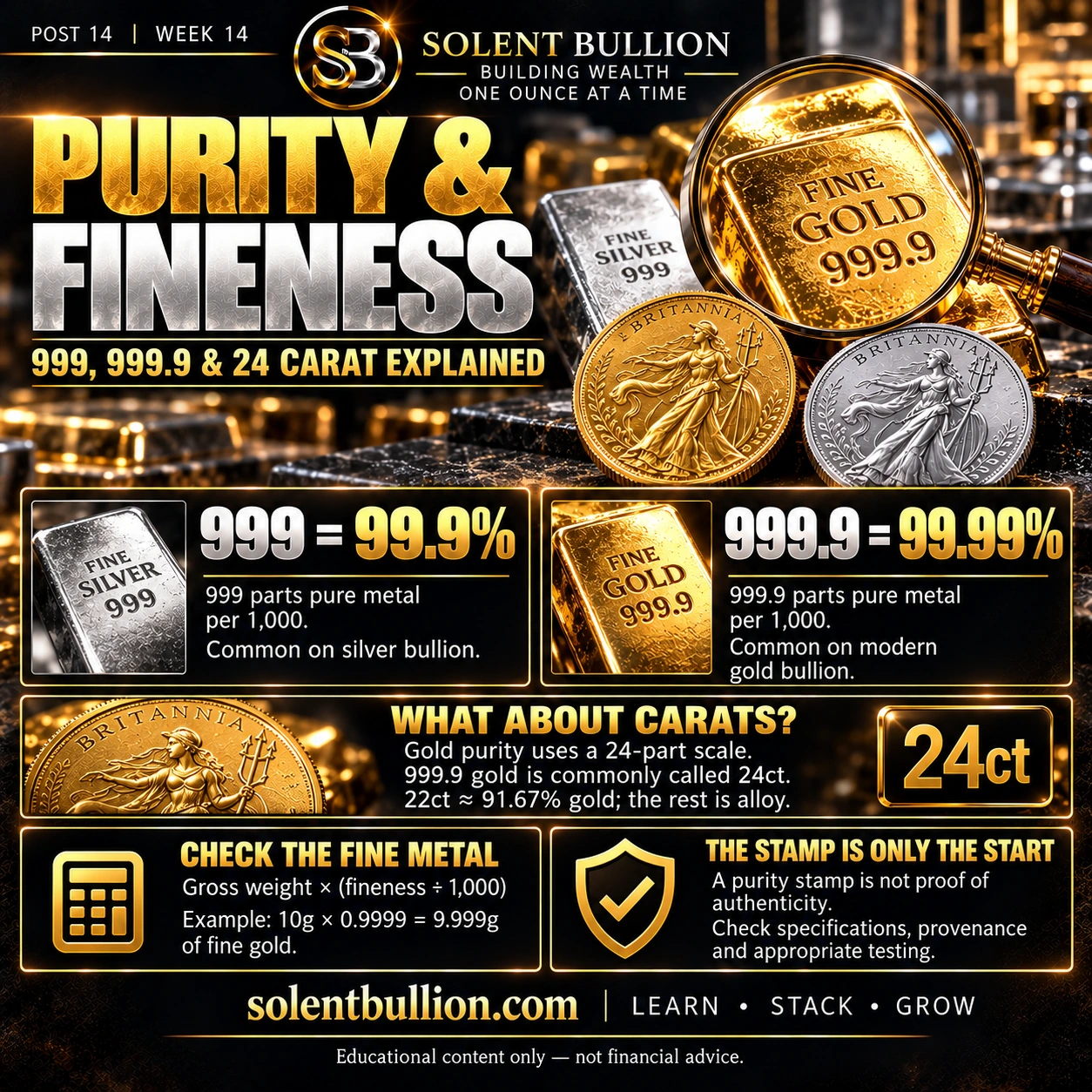
Purity is the proportion of a material made up of a particular metal. Fineness expresses that proportion in parts per thousand. To turn a fineness number into a percentage, divide it by ten: 999 becomes 99.9%, while 999.9 becomes 99.99%.
The metal name matters as much as the number. A 999 silver product and a 999 gold product have the same stated proportion of their named metal, but contain different metals. The remaining material may include other metals or trace impurities, depending on the product and its specification.
Reading common fineness figures
Fineness
Precious-metal proportion
999
99.9% of the named metal
999.9
99.99% of the named metal
925 silver
92.5% silver, commonly called sterling silver
The decimal point is significant. Moving from 999 to 999.9 changes purity by 0.09 percentage points. It is a small compositional difference, not a statement that an item is nine or ten times more valuable.
What does 24 carat mean?
Carats describe gold purity using a 24-part scale. The ideal proportion is calculated as the carat figure divided by 24. For example, 22 ÷ 24 is approximately 0.916667, or 91.67% gold. The same arithmetic gives 75% for 18-carat gold.
24 carat is the pure-gold category, and modern 999.9 gold bullion is commonly described that way. The term does not replace a precise product specification or promise mathematically perfect 100.000% purity. Read the stated fineness when you want to compare exact standards.
You may see “karat” in American descriptions of gold. This use concerns purity. A gemstone carat, by contrast, is a unit of mass; it is a different measurement.
22-carat gold can still be bullion
Alloyed gold is not automatically a lower-quality or unsuitable bullion product. The Royal Mint’s 2026 Sovereign is a 22-carat gold coin, with a published fineness of 916.67. Its non-gold portion is part of the alloy rather than evidence that the coin is counterfeit.
The useful comparison is how much fine gold a particular item contains, together with its full price and product characteristics. Two coins with different purities can be designed to contain the same amount of fine gold while having different total weights. Never assume that a Sovereign, a Britannia and a generic “gold coin” are interchangeable sizes.
Real examples: read the exact product specification
2026 one-ounce gold Britannia: The Royal Mint lists 999.9 fineness and one troy ounce of pure gold.
2026 one-ounce silver Britannia: the corresponding specification lists 999 fineness and one troy ounce of pure silver.
2026 Sovereign: a different coin with a different specification, including its 22-carat gold alloy.
These examples identify particular issues. Other dates, denominations and products may have different specifications, even where their names or designs look familiar. Check the original mint’s information for the exact item.
Gross weight and fine-metal weight
Gross weight means the total mass of the metal item. Fine-metal weight means the amount of the named precious metal within it. A capsule, assay card or outer packaging is not part of the item’s metal weight.
Calculation: gross metal weight × (fineness ÷ 1,000) = fine-metal weight. For gold expressed in carats, the theoretical proportion is carats ÷ 24. Use the manufacturer’s precise figures where available.
The following are fictional calculation examples based on an explicitly stated gross metal weight and fineness, rather than claims about particular products:
Worked fine-metal calculations
Item specification
Fine-metal content
10g at 999.9 gold
10 × 0.9999 = 9.999g of gold
100g at 999 silver
100 × 0.999 = 99.9g of silver
10g at 22-carat gold
10 × (22 ÷ 24) ≈ 9.1667g of gold
A common mistake: reducing a stated fine ounce again
Some bullion products are described by their fine-metal content rather than their gross weight. If a reliable product specification already states one troy ounce of pure gold, do not multiply that fine ounce by the fineness again. Doing so would apply the purity adjustment twice.
Start by asking what the quoted weight measures. Is it the whole metal item, or the precious metal it contains? Then check whether the unit is grams, kilograms or troy ounces. Our Week 13 guide to bullion weights explains the unit conversion.
Higher purity does not settle the whole comparison
A purity figure cannot tell you the full purchase cost, the amount a buyer might offer later, the product’s condition or the quality of its provenance. A comparison should keep the same metal and fine-metal unit, then consider the actual item and its terms.
Purity also says nothing about a guaranteed future return. A higher fineness number does not mean a product’s market price must rise faster. The bullion-premium deep dive explains why the price paid can differ from the underlying metal reference value.
A stamp and an independent hallmark are different things
A stamped number, a printed assay card and a full UK hallmark should not be treated as identical forms of evidence. Official UK hallmarking guidance describes several identifying marks, including the sponsor, fineness and assay-office marks. A lone number on an item does not, by itself, establish that the item has undergone that process.
Keep the product description, seller records and any relevant original documentation together. Compare the exact mint’s published specifications and security features. If you need assurance about an unfamiliar item, use appropriately qualified testing rather than relying on the stamp or appearance alone. Hallmarking requirements and exemptions depend on the item; consult the current official guidance for a particular case.
Your practical reading checklist
Identify the metal and the exact product, issue year and denomination.
Read the fineness or carat figure and convert it correctly.
Establish whether the quoted weight is gross metal weight or fine-metal content.
Check the units and any published rounding.
Compare the figures with the original manufacturer’s specification.
Check provenance and appropriate authentication evidence alongside the numbers.
Check your understanding
1. Does 999 mean 99.99%? No. It means 99.9%. A fineness of 999.9 corresponds to 99.99%.
2. Must a genuine bullion coin be 24 carat? No. Established bullion coins can use other gold alloys; the Sovereign is a 22-carat example.
3. A specification already states one troy ounce of fine silver. Should you multiply it by 0.999? No. The stated fine content has already accounted for purity. Check the specification rather than adjusting it twice.
Key takeaway: Read the metal, purity and weight together. Understand what each figure measures, then check the product’s specification and authenticity evidence. The stamp is the beginning of the enquiry.
Sources and further reading
Definitions and product examples checked on . The worked calculations are Solent Bullion teaching examples.
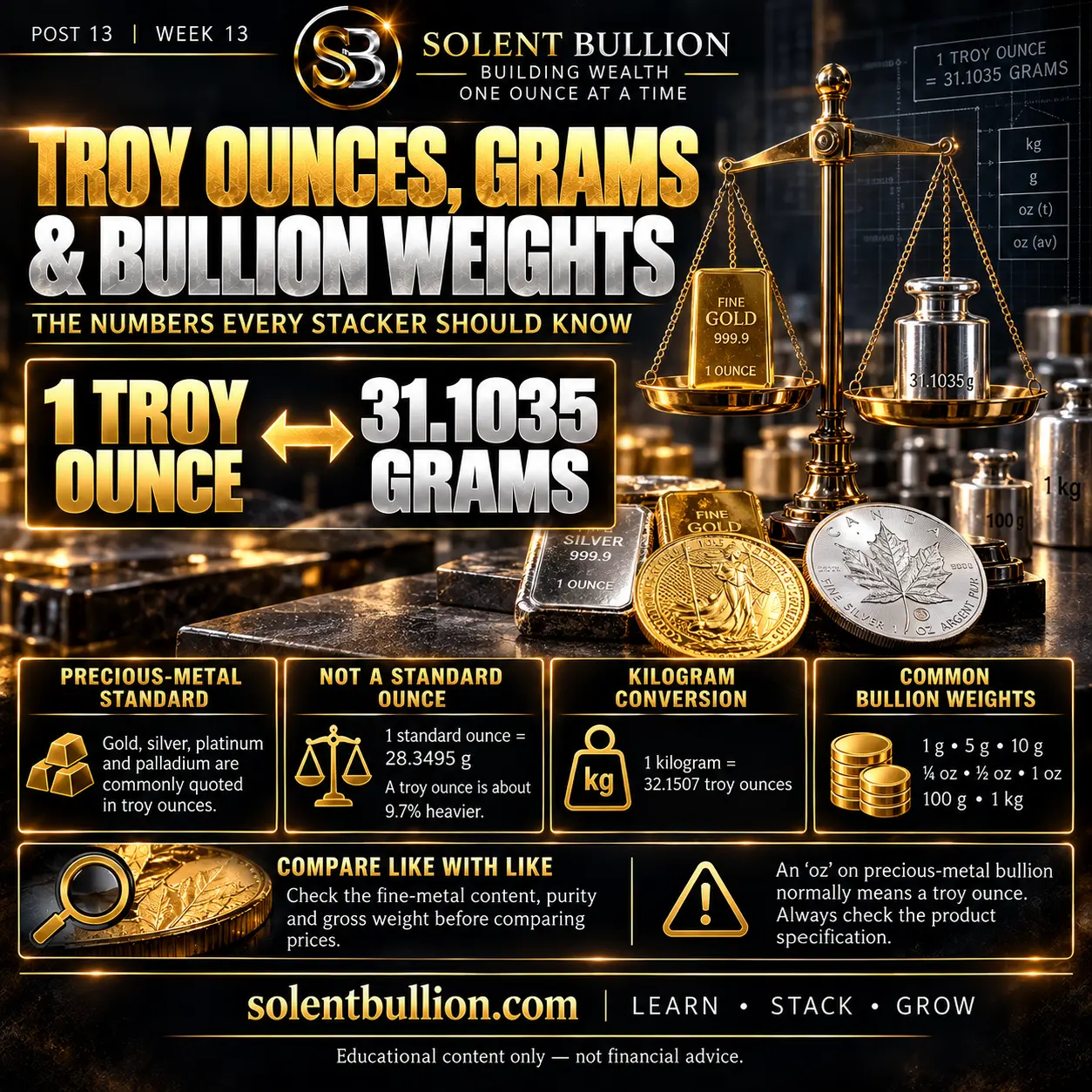
Precious metals use a weight system that can look familiar while meaning something different. Gold and silver prices are commonly quoted per troy ounce, while many bars are labelled in grams or kilograms. Understanding the units makes it easier to compare products accurately.
A troy ounce is not an everyday ounce
One troy ounce equals exactly 31.1034768 grams. The everyday avoirdupois ounce used for many ordinary goods is about 28.3495 grams. The difference is roughly 2.754 grams, so substituting one for the other can materially change a bullion comparison.
1 troy ounce31.1035 g
1 ordinary ounce28.3495 g
1 kilogram32.1507 oz t
Gross weight and fine-metal content
The total weight of a product and the amount of pure precious metal inside it are not always identical. Fineness states how much of the material is the named precious metal. A bar marked 999.9 gold is 999.9 parts gold per thousand; a 100-gram bar at that fineness contains 99.99 grams of fine gold. Alloyed coins can weigh more overall while still containing a stated amount of fine metal.
Simple calculation: gross weight × fineness ÷ 1,000 = fine-metal content. Always use the manufacturer’s specification for the exact product rather than relying on appearance or a rounded description.
Common bullion sizes
Coins and bars can be sold in full, fractional and metric sizes. You may see 1 oz, ½ oz, ¼ oz and 1/10 oz coins alongside 1 g, 5 g, 10 g, 100 g and 1 kg bars. A quarter troy ounce is about 7.7759 grams of fine metal; it is not the same as a 7.5-gram or 8-gram product.
Why the distinction matters
Price comparison: convert products to the same fine-metal unit before comparing premiums.
Product checks: read the stated weight, fineness and fine-metal content together.
Storage planning: a collection’s total mass and its fine-metal content may differ.
Resale conversations: dealers commonly describe precious-metal weights in troy ounces or metric units, so using the correct unit avoids confusion.
A quick product checklist
Does “oz” mean troy ounce in this listing?
Is the stated figure gross weight or fine-metal weight?
What fineness is marked or documented?
Am I comparing like with like: grams with grams, or troy ounces with troy ounces?
Does the calculation agree with the product specification?
Key takeaway: One troy ounce is 31.1034768 grams—not the 28.3495-gram everyday ounce. Compare bullion using fine-metal content, the correct unit and the stated fineness.
Building a bullion collection is not only about understanding coins, bars and prices. It also helps to understand the decisions and emotions that can shape how we buy. A clear personal plan can make it easier to stay thoughtful when prices move or online conversations become noisy.
Start with your reason
People are drawn to physical precious metals for different reasons: learning about money, collecting, owning a tangible asset or adding a particular asset to a wider financial picture. Write down what matters to you. A reason you can explain calmly is more useful than a purchase made because everyone else seems to be buying.
Choose a pace that fits your circumstances
There is no required amount, schedule or finish line. Make everyday commitments and financial priorities part of the decision. MoneyHelper recommends understanding the risks and considering your financial situation before investing. Waiting, researching or deciding not to buy are all valid choices.
Expect uncertainty and understand the full price
Gold and silver prices can rise and fall. With physical bullion, the spot price is only one part of the decision: the product premium, delivery or storage costs, and the price available if you later sell can also matter. Before buying, understand the total price and ask how the product could be sold back. Do not treat past performance or a price forecast as a promise about the future.
Notice pressure before it becomes a decision
Urgency, fear of missing out and claims of guaranteed returns can make it harder to think clearly. Take time to check the product, seller, costs and claims. The FCA’s InvestSmart guidance encourages people to ask questions and look out for hype and pressure tactics before investing.
Keep your own scoreboard
Social posts can make other people’s collections look larger or their results look certain. Those posts rarely show the full context. Your goals, budget and time horizon are personal; there is no need to match somebody else’s pace or collection.
A calm pause before a purchase
Can I explain why this purchase fits my own plan?
Have I checked the total cost, including any premium and delivery?
Do I understand that the value can fall as well as rise?
Have I checked the seller and the terms for a future sale?
Would I still make this decision if I waited until tomorrow?
Key takeaway: A thoughtful stacking habit is built around informed choices, realistic expectations and a pace that suits you. The goal is not to react to every move in the market.
Important information
Direct investments in commodities such as physical gold are generally not regulated by the FCA in the same way as regulated investment products. Protections can differ. Check the specific product, seller and service, and seek independent guidance if you are unsure. This article is general education, not personal financial advice or a recommendation to buy bullion.
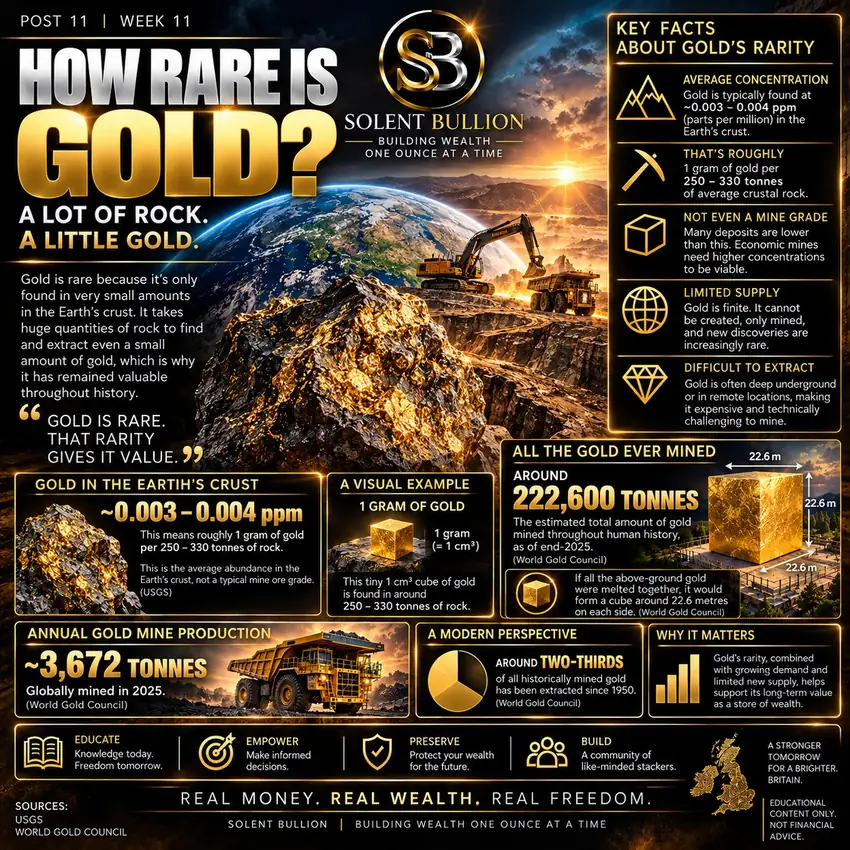
Gold is present in the Earth’s crust, but usually in very small concentrations. A US Geological Survey circular published in 1968 reported broad crustal abundance estimates in the range of roughly 0.001–0.006 parts per million. That broad average is not the same as the grade of a mine: gold deposits form where geological processes concentrate the metal into particular locations.
From trace amounts to a mine
Exploration teams look for deposits where enough gold may be recovered. Whether a deposit becomes a mine depends on much more than geology: depth, ore grade, processing methods, energy, labour, infrastructure, environmental requirements, permits, financing and the expected price all affect technical and economic viability. A deposit can exist without being a profitable or permitted mine.
New mine supply is only one part of the market
Opening or expanding a mine can take years, so mine production does not respond instantly to short-term price moves. Existing gold can also be recycled or sold back into the market. The World Gold Council estimates that more than 220,000 tonnes have been mined through history; because gold is durable, much of it remains in jewellery, official reserves, bars, coins and other forms. Above-ground gold is therefore a large source of potential supply as well as a record of past mining.
Think in stocks and flows
The “stock” is the gold already above ground. The “flow” is newly mined or recycled gold entering the market over a period. Comparing annual mine production with all the gold already mined can help explain why mine output is not the only measure of available supply. It does not, by itself, predict price: demand, recycling, investor selling and many other conditions matter.
Rarity is one part of value
A scarce material is not automatically valuable. Gold’s market value also reflects demand, recognisability, durability, uses, liquidity and the costs and risks of owning it. Scarcity is a useful part of the explanation, not a guarantee of future performance.
Key takeaway: Gold is rare in ordinary rock, but mine-grade deposits are local concentrations. Mine production, recycling, above-ground stocks and demand all belong in the full supply picture.
Central banks manage official reserves to support their countries’ external and financial resilience. Those reserves can include foreign currencies, government securities and gold. Gold’s place in a reserve portfolio reflects institutional history and strategic choices; it does not mean that a household should copy a central bank’s balance sheet.
What gold can contribute
Physical gold is not another institution’s promise to pay interest or repay principal, so it has no issuer credit risk in the same way as a bond or bank deposit. It is traded in a global market and may diversify some reserve portfolios. These are characteristics that can matter to a reserve manager, but the benefits depend on the portfolio, time horizon and market conditions.
What gold does not solve
Gold prices are volatile and it does not pay interest. Holding and mobilising physical gold requires secure storage, operational arrangements and access to a market. Recent IMF analysis also stresses that gold’s diversification and hedging effects are conditional, and that gold may be less suitable for reserves needed immediately as liquid foreign exchange.
Why central-bank buying is not a price signal
Official purchases can attract attention, but central banks have different mandates, time horizons, resources and reasons for holding reserves. Their decisions can change, and reported purchases do not establish what the price will do next. A headline about central-bank demand is one piece of market context—not a personal buy recommendation.
How to learn from the comparison
Separate the reasons an institution holds an asset from your own needs.
Ask whether the asset produces income, what risks it carries and how quickly it can be sold.
Look at several years of reserve and demand data rather than one headline.
Remember that physical bullion has costs and price risk for individual owners too.
Key takeaway: Central banks may value gold as one component of official reserves. Their choices illustrate gold’s role in institutional portfolios but do not prove it is suitable for everyone.
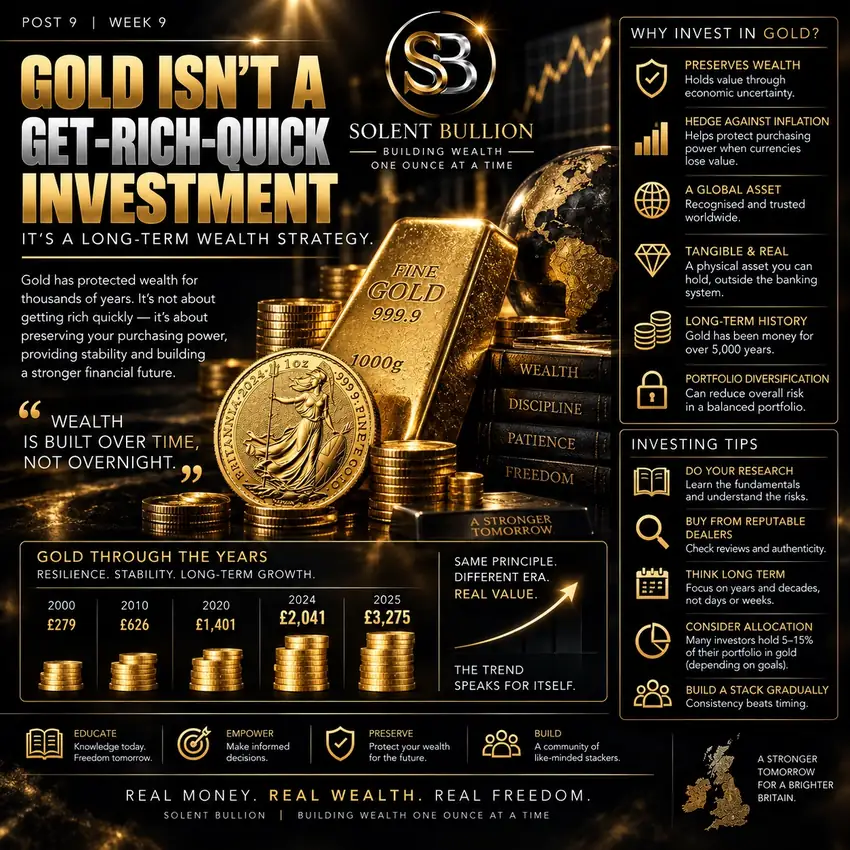
Physical gold is sometimes presented online as an easy route to fast profits or guaranteed protection. Neither claim is dependable. Gold prices rise and fall, and the future selling price is unknown. A long-term interest in bullion is different from a promise that a purchase will make money over a short period.
Know what drives the outcome
Your result depends on more than the headline gold price. The purchase premium, any delivery or storage costs, the price offered when you sell, the currency exchange rate and the time you need to hold the metal may all matter. Gold does not pay interest or dividends, so an owner’s financial return comes from selling for more than the total cost of ownership.
Put the decision in context
Before buying, ask what role you expect gold to play and how it fits your wider finances. Money set aside for near-term bills, debt repayments or an emergency may have a different purpose from money you can leave invested. Precious metals can fall in value and may be difficult or costly to sell quickly in the exact form you hold.
Recognise pressure and hype
Be cautious of countdowns, “once-only” opportunities, claims that prices can only rise, and influencers urging immediate action. The FCA advises people to take time, understand the opportunity and the risks, and be alert to hype and fear of missing out. A pause is useful when the seller’s urgency is doing more work than the product explanation.
A pre-purchase pause
Can I explain why this product fits my own plan?
Do I understand the total cost and how resale works?
Could I tolerate a fall in value or a long wait to sell?
Have I checked the seller and the claims independently?
Would I still choose this if I waited a day?
Key takeaway: Treat bullion as an asset with risks and costs, not a guaranteed short-term profit. Make the decision at your own pace and within your circumstances.
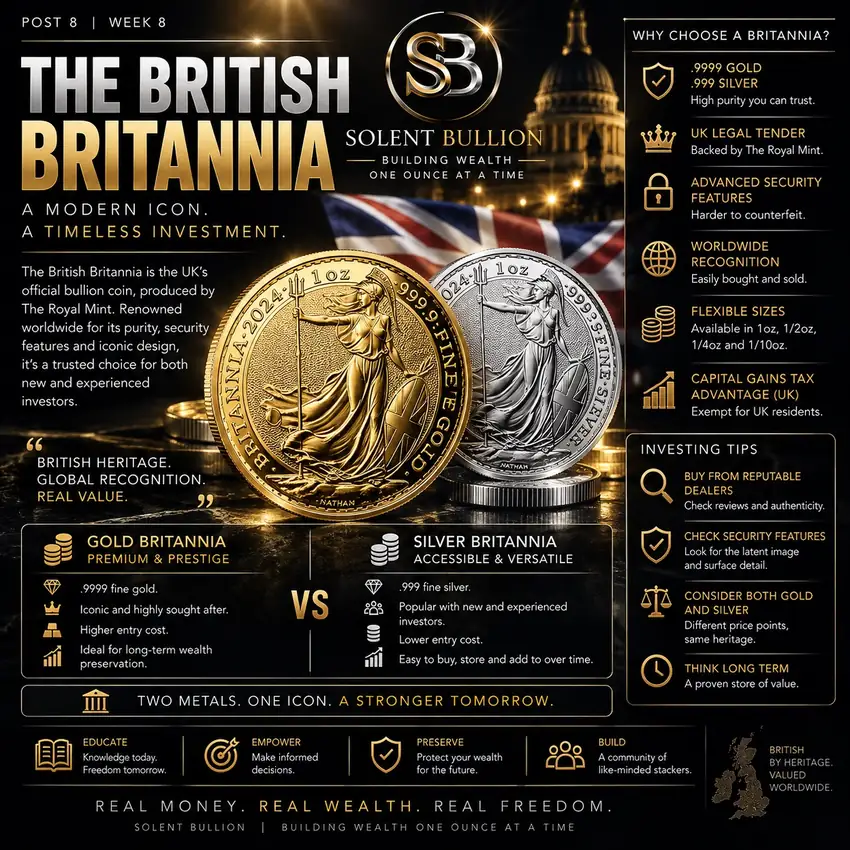
Britannia is a bullion coin family produced by The Royal Mint. The design draws on the historic personification of Britain, while modern issues are made in different metals, weights and years. A familiar name can make a coin easier to recognise, but each specific product still needs to be checked on its own details.
Read the exact specification
Look for the metal, gross weight, fine-metal content, fineness, denomination, year and condition. These details can vary across gold, silver and other Britannia products. For example, The Royal Mint’s 2026 one-troy-ounce gold Britannia is listed as 999.9 fine gold; do not assume that every item carrying the Britannia name has identical specifications.
Understand the design and security features
Recent Britannia bullion issues use visual security features such as micro-text, a latent image, surface animation and fine-line detailing. These features can help with visual checks, but a photograph or a single feature is not a complete authenticity test. Buy from a reputable dealer, compare the item with official product information and keep purchase documentation.
Consider the purchase as a whole
Compare the delivered price with the reference value of its fine-metal content. Also check the dealer’s buy-back terms, packaging, storage and any tax implications for your circumstances. UK tax treatment can depend on the coin’s legal status and the details of the transaction; consult current HMRC guidance or an appropriately qualified adviser rather than relying on a general social-media claim.
Checklist for a Britannia
Is it gold or silver, and what is its stated fineness?
What is the exact fine-metal weight and issue year?
Does the price make sense against the metal value and comparable products?
Can the dealer explain authenticity checks and resale terms?
Have you checked current tax guidance for the exact coin and your circumstances?
Key takeaway: Britannia is a recognisable coin family, not a substitute for checking the exact coin, its price, authenticity and terms.
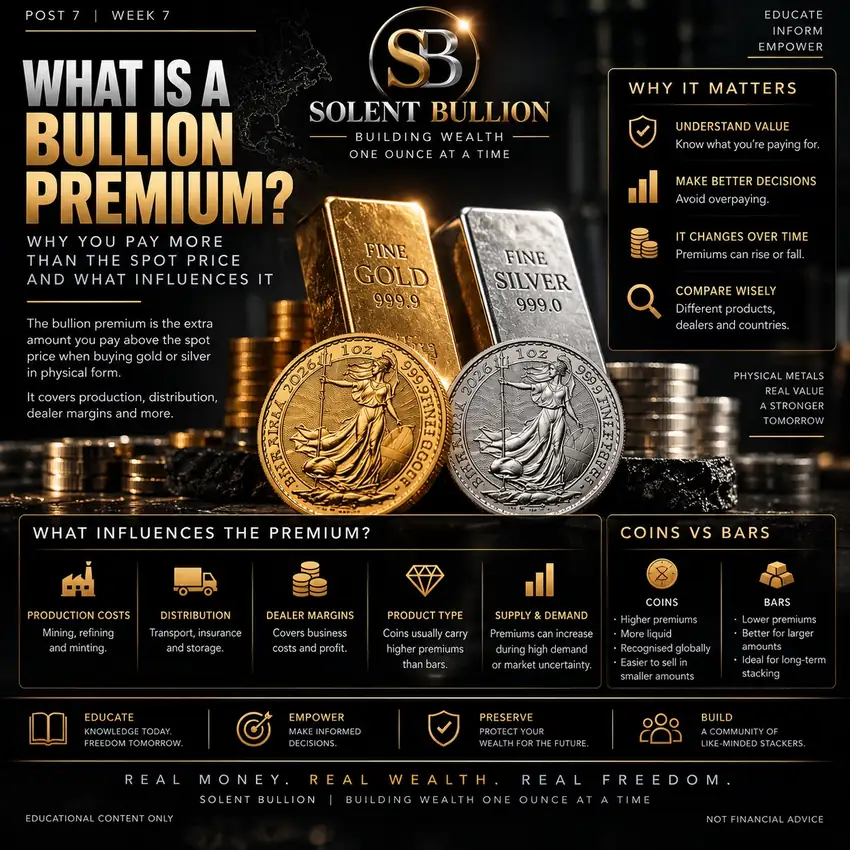
The spot or benchmark price estimates the metal value of a product. The premium is the amount charged above that reference value for the finished bullion item and the services that bring it to the buyer. The premium is part of the purchase price; it is not an additional amount of metal.
A simple calculation
For a product with one troy ounce of fine metal:
Premium amount = product price − indicative fine-metal value
For example, if the reference value were £2,000 and a hypothetical product cost £2,100 before delivery or tax, the difference would be £100, or 5% of the reference value. This is only an illustration: actual product prices and premium structures vary.
Why premiums differ
Manufacturing, refining, packaging, distribution, dealer operating costs, availability, product size and customer demand can all contribute. A small coin or bar may cost more per ounce to make and distribute than a larger format, although the final premium is not fixed and can change with market conditions. Dealers may quote a percentage or a cash amount.
Why the resale price matters too
The premium paid when buying does not necessarily return to you when selling. A dealer’s buy-back quote may be below the current reference metal value or differ from that dealer’s retail price. Your eventual result can be affected by the metal-price movement, the original premium, the resale price and any other costs.
Compare products carefully
Use the same metal, fine weight, product type and quote time.
Compare total delivered prices, including any applicable taxes.
Check the dealer’s current buy-back terms for the exact item.
Consider whether a premium is buying something you value, such as a particular size, mint or recognised design.
Key takeaway: Compare the total amount you pay and the likely resale route—not just the premium percentage in isolation.
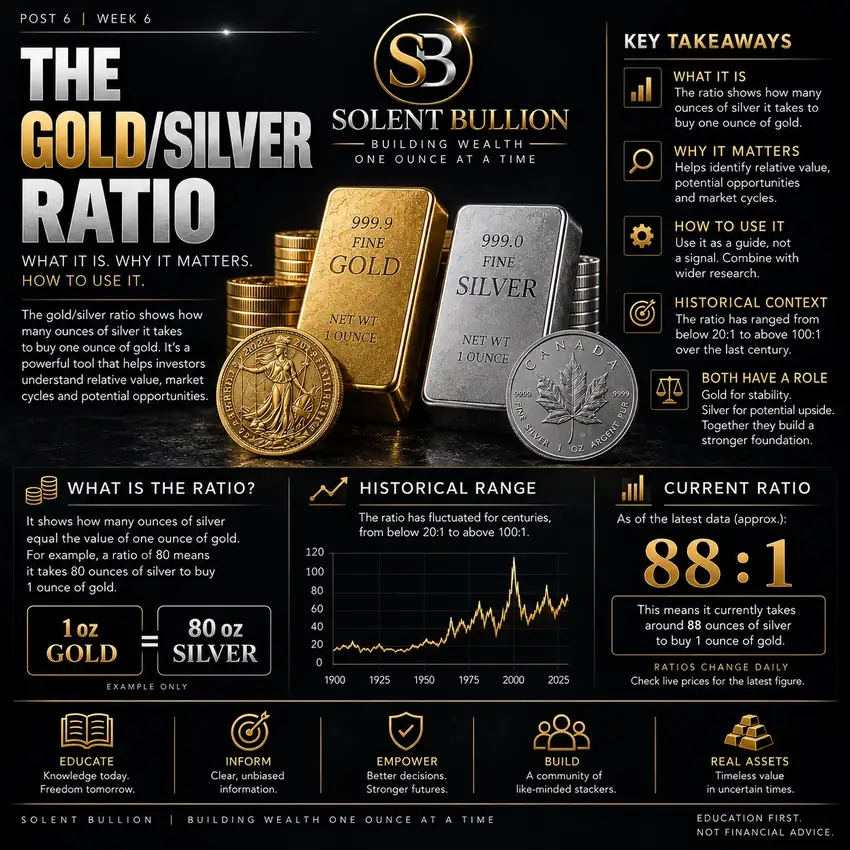
The gold/silver ratio compares the market prices of gold and silver. It tells you how many ounces of silver have the same quoted value as one ounce of gold at a given moment.
How to calculate it
Divide the gold price per troy ounce by the silver price per troy ounce, using the same currency and comparable quote times.
Example: If gold were £2,400/oz and silver £30/oz, the ratio would be 80:1. Those are illustrative numbers, not current prices or a signal to trade.
A ratio of 80:1 means the quoted price of one ounce of gold equals the quoted price of 80 ounces of silver. It does not mean that one ounce of gold contains the same physical amount of silver, or that the metals should trade at any particular ratio.
What can move the ratio?
Gold and silver have overlapping but different demand drivers. Gold demand includes jewellery, investment, official reserves and technology. Silver has substantial industrial uses alongside investment and jewellery demand. Changes in interest-rate expectations, currency movements, investor behaviour, manufacturing demand or supply can affect one metal more than the other.
What the ratio cannot tell you
The ratio is a description of relative prices, not a forecast. It has no fixed “correct” level and cannot say when either metal will rise or fall. A high ratio does not guarantee silver is undervalued; a low ratio does not guarantee gold is due to outperform. Physical products also have different premiums, taxes and buy/sell spreads, none of which the spot-price ratio includes.
Use it as context, not a rule
Check that both prices use the same currency and unit.
Look at the ratio over more than one time period.
Ask what may be driving each metal rather than relying on one number.
Compare actual product costs separately if considering physical coins or bars.
Key takeaway: The ratio is a simple comparison tool. It is not a buy/sell signal or a promise about future performance.
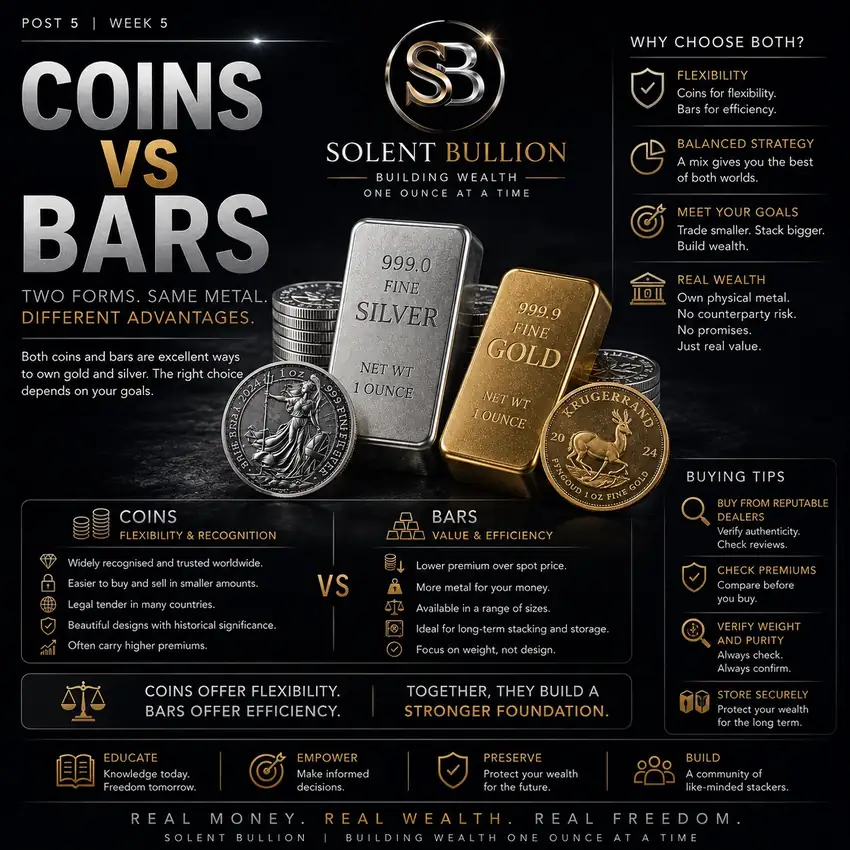
Gold and silver bullion is commonly sold as coins or bars. Both can contain a stated quantity of fine metal, but they differ in format, range of sizes, manufacture, packaging and how buyers may compare them. The right choice depends on your priorities and the exact product—not on a universal rule that one format is always best.
What bullion coins can offer
Coins are often issued by recognised mints in standard weights and may carry familiar designs. A range of fractional sizes can make it possible to buy or sell in smaller units. Some coins also attract collector interest; when that happens, the price may reflect more than metal content, and collectible premiums can change independently of the metal market.
What bullion bars can offer
Bars come in many weights, from small units to larger formats. Larger bars can sometimes have a lower premium per ounce, but this varies by product, stock and seller. A larger item may also be less divisible: if you want to sell only part of your holding, you cannot divide a single bar into standard sale units.
Compare the whole ownership experience
Fine-metal content: check weight and fineness, not just the product name.
Total price: include premium, delivery and any applicable tax.
Recognition and resale: ask what documentation or testing a buyer may require and how the dealer prices buy-backs.
Authenticity: buy from a reputable source and retain invoices and packaging where relevant.
Storage: consider security, insurance, access and record-keeping before your holding grows.
Example comparison
When comparing a one-ounce coin with a one-ounce bar, compare their fine-metal content and full delivered prices. If the bar appears cheaper, also consider brand, assay or serial details, resale options and how readily you could sell that particular product. A lower premium alone does not settle the decision.
Key takeaway: Coins and bars are different ways to hold physical metal. Compare exact specifications, total cost, resale terms and practical fit.
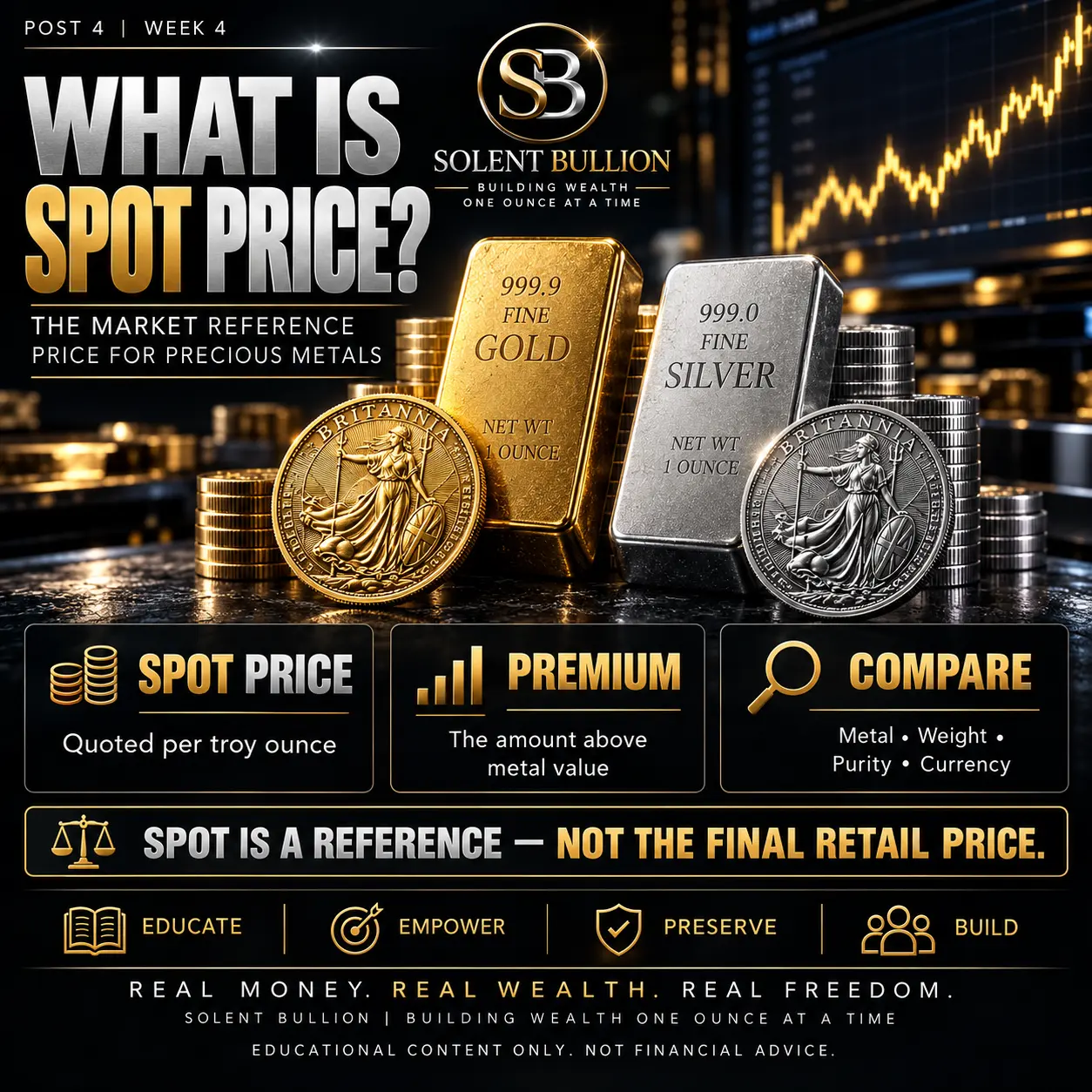
Spot price is a market reference for precious metal, commonly quoted per troy ounce. It helps buyers and sellers discuss a shared underlying value, but it is not automatically the price of a finished physical coin or bar at checkout.
Benchmarks and live market references
For London precious metals, the LBMA prices are widely used benchmarks. The gold benchmark is set in auctions twice each business day; the silver benchmark is set once each business day. Other market quotes can move continuously. The time, currency, market and type of quote therefore matter when comparing figures.
Why the price you pay is different
A simple starting calculation is:
Indicative metal value = fine-metal weight × relevant metal price
The retail price may then include a product premium, dealer and distribution costs, delivery, and any applicable tax. Currency conversion matters too: an international metal price may be quoted in US dollars, while a UK buyer pays in pounds. Exchange-rate movements can affect the sterling reference value even when the dollar price is unchanged.
Worked example—not a live quote
If a hypothetical item contains one troy ounce of fine gold and a reference price is £2,000 per ounce, its indicative metal value is £2,000. A dealer’s product price could be higher because of the premium and other costs. The figure does not tell you what another dealer charges or what a buyer would later pay to purchase the item from you.
Compare like with like
Use the same metal, currency, weight and fineness.
Note the quote time and whether it is a benchmark or indicative live price.
Compare the full price, not just the spot figure or premium label.
Check the dealer’s buy-back price separately; it may differ from the selling price.
Key takeaway: Spot price is a useful reference point. The full cost of physical bullion depends on the product, seller, currency and transaction.
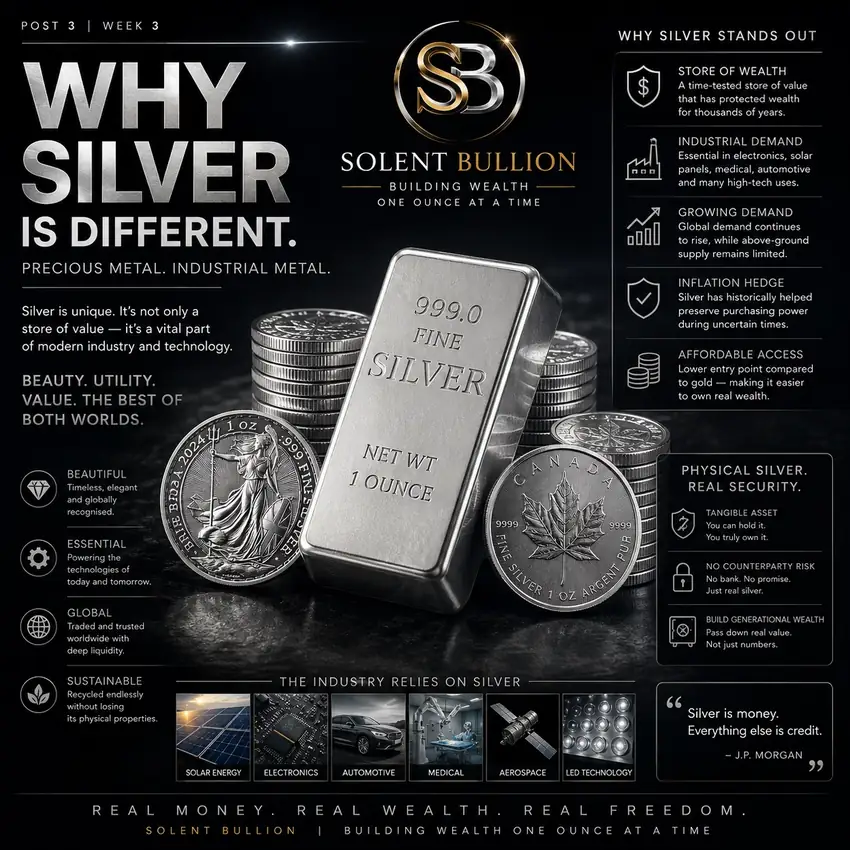
Silver is both a precious metal and an important industrial material. It has a long history in jewellery, coins and exchange, while its physical properties—especially its high electrical and thermal conductivity and reflectivity—make it useful in a range of manufactured products. That combination gives silver a different demand mix from gold.
Two broad sources of demand
Silver demand includes investment and jewellery, as well as industrial use in areas such as electrical and electronic products, mirrors and other applications. The balance changes as manufacturing needs, technology, consumer demand and investor interest change. This means silver can be influenced by both precious-metals sentiment and wider industrial conditions.
Why its price can behave differently
Silver’s market is smaller than gold’s, and its industrial links can make its price more sensitive to changes in economic expectations. It can move sharply in either direction. Some people describe silver as “cheap gold” because one ounce costs less, but the lower unit price does not make the two metals interchangeable or tell you which is better value.
Physical silver brings practical considerations
At the same monetary value, silver usually takes up more space and weighs more than gold. Product premiums, packaging, storage and applicable taxes can also affect the total cost. Check the exact item, total checkout price and any available resale terms rather than comparing only a headline spot price.
A useful comparison checklist
What is the item’s fine-silver content, weight and fineness?
Is it a bullion product or a collectible whose price may include a separate collector premium?
How much will it cost after delivery and any applicable tax?
How will you store it, and how would you sell it if your plans changed?
Key takeaway: Silver’s industrial uses create a distinct demand profile and its price can be volatile. Understand those differences before comparing it with gold.
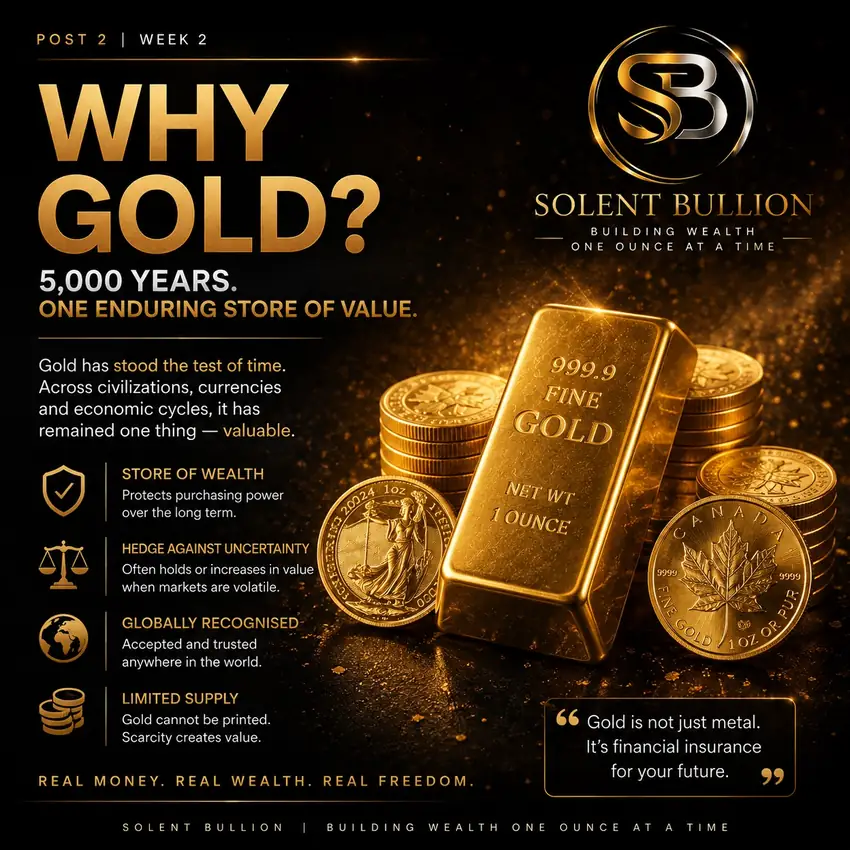
Gold is a chemical element with an unusual combination of properties: it is durable, workable, conducts electricity and resists corrosion. People have used it for jewellery and exchange for thousands of years; today it also appears in investment products, official reserves and some technology. Those uses help explain gold’s enduring interest, but they do not guarantee a particular price or return.
Four characteristics that help explain gold’s appeal
Durability: gold does not rust or tarnish easily, so it can be reused and recycled over long periods.
Recognisability: standardised coins and bars can be assessed by their stated weight and fineness, although authenticity still needs checking.
Divisibility: gold can be formed into different weights, letting buyers compare smaller and larger units.
Scarcity and supply: new mine supply takes time and investment to develop, while existing above-ground gold can also be resold or recycled.
Gold has more than one source of demand
Jewellery, bars and coins, exchange-traded products, central-bank reserves and technology all contribute to demand. Their relative importance changes over time. A strong year for one category does not mean every category is growing, and no single buyer group sets the price on its own. The World Gold Council’s demand reports show how these categories can move differently.
What physical gold does—and does not—do
A gold coin or bar is a tangible asset, but it does not pay interest or dividends. Its value in pounds changes with the metal’s market price and the exchange rate, while the amount you could receive when selling depends on the buyer, product and market conditions. Storage, security, insurance and dealing costs can also matter.
Questions to ask before you compare products
What is the fine-gold content, weight and fineness?
How does the total price compare with the metal’s reference value?
How would I check authenticity and arrange secure storage?
What might a dealer pay to buy this exact item back?
Key takeaway: Gold’s physical properties and broad uses help explain why it remains widely recognised. They do not remove price risk or make every product suitable for every person.