The election changes the political balance. Markets respond to what that might mean for policy, interest rates and currencies. For a UK bullion owner, understanding those links is more useful than treating a single trading session as a forecast.
What has happened?
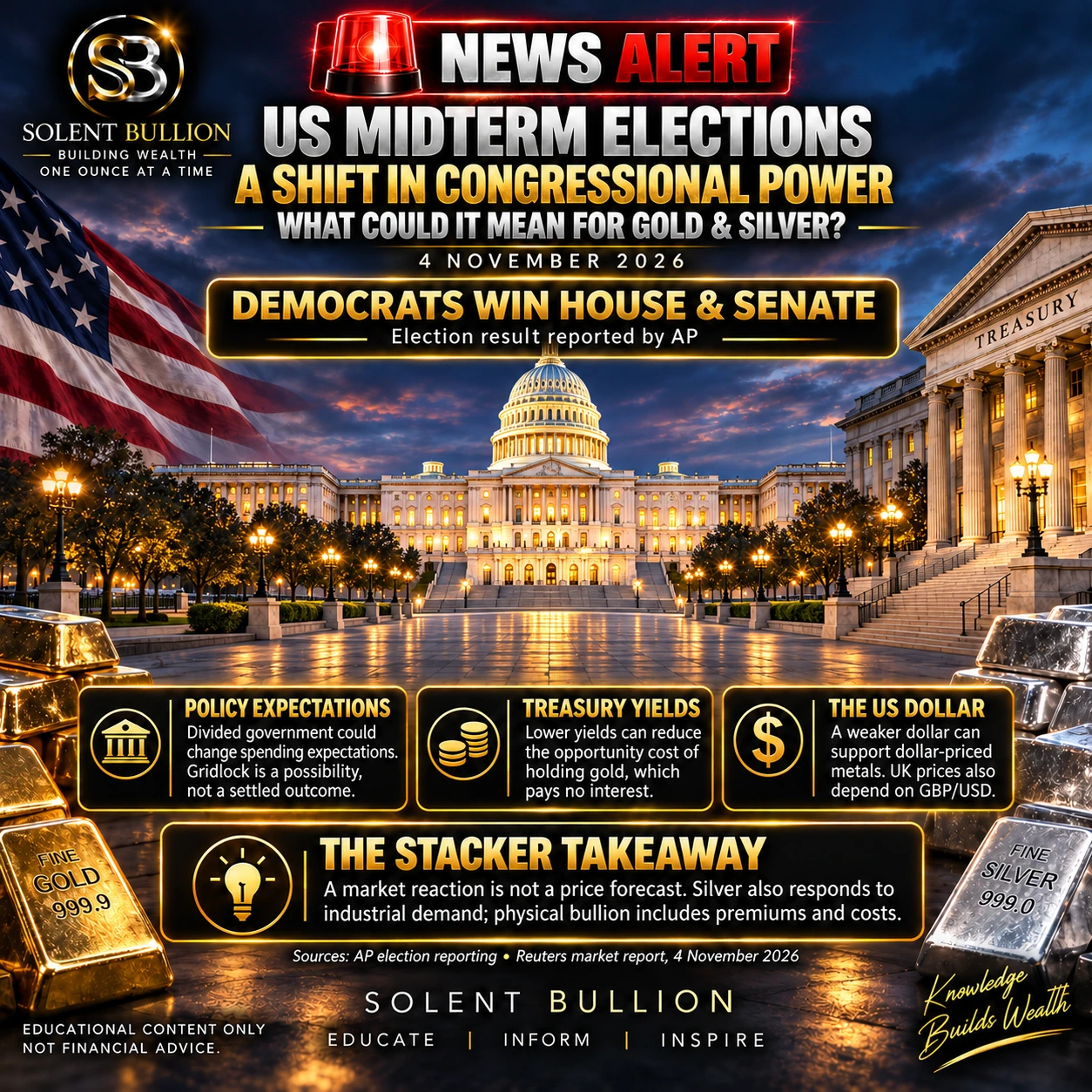
Associated Press reports that Democrats won both the House of Representatives and the Senate in the US midterm elections held on 3 November 2026. That result sets up a different congressional balance alongside President Donald Trump’s administration.[1]
Reuters reported stronger gold and silver prices and a weaker dollar on 4 November as investors assessed the outcome. Its reporting discussed fiscal uncertainty and the Federal Reserve outlook as part of the market context.[2] This article focuses on the economic mechanisms, rather than reproducing a price-update board.
The election outcome and market reporting are sourced facts. The explanations and scenarios below are Solent Bullion analysis. A reported result does not mean a new Congress has already taken office or enacted a different budget.
A new balance of power is not a new policy overnight.
Think of three separate stages: an election result, the policies people expect from it, and the decisions that eventually take effect. Financial markets can reprice expectations before the third stage exists.
Result
A different congressional balance.
Expectations
Investors reassess possible outcomes.
Decisions
Actual legislation and implementation.
Divided government could make some spending or tax proposals harder to pass. It could also produce compromise. Neither outcome is established simply by knowing which party won. Our analytical question is what the result changes about the likelihood of particular decisions, rather than whether one party is automatically good or bad for gold.
Consider two possible interpretations. Investors might expect fewer large spending packages and reassess future borrowing. Alternatively, they might focus on disputes and uncertainty over future budgets. Both are scenarios, not findings about what Congress will do. A thoughtful analysis leaves room for the interpretation to change as proposals become concrete.
Why can bond yields matter to gold?
Gold pays no contractual interest. When returns available elsewhere change, the comparison with holding gold changes too. Lower yields can reduce that opportunity cost; higher yields can increase it. It is a relationship to examine, not a mechanical trading rule.
Research published by the Federal Reserve Bank of Chicago discusses expected long-term real interest rates among the drivers of gold. “Real” means allowing for inflation: a nominal yield tells only part of the story.[3]
For illustration, a nominal yield can fall while expected inflation falls even further. In that case the inflation-adjusted comparison need not move in the direction suggested by the nominal yield alone. The point is to ask which measure a market commentary is describing.
Our graphic explains the possible lower-yield channel. It does not establish that every Treasury maturity moved together or that yields alone caused the metals’ response. Election coverage, economic releases and other market developments can overlap.
Does a congressional election set the Federal Reserve’s next rate decision?
No. The Federal Reserve describes its monetary-policy decisions as independent of political influence, within the goals set by Congress.[4] A result can alter investors’ expectations about the economy; it does not by itself announce a rate change.
The dollar is one link in a larger chain.
Reuters identifies the weaker dollar as support for gold in its report. Dollar-priced metal becomes less expensive in another currency when that currency strengthens against the dollar, all else equal. That can affect demand, but the currency move and the metal price can both keep changing.
The World Gold Council groups currencies, interest rates, risk and other factors among gold’s interrelated drivers.[5] That broader framework helps explain why a single political headline cannot settle the next price.
What changed in policy expectations?
What changed in yields and currencies?
It would be too strong to say that an election guarantees a weaker dollar or stronger metals. Today’s explanation is a dated interpretation of a developing situation, not a permanent relationship between a party label and an asset price.
Silver is not simply gold with a smaller price tag.
The Silver Institute describes silver’s use in electrical and electronic applications.[6] That gives us another question alongside investment sentiment: what is happening to the industries that consume the metal?
As an analytical possibility, a policy outlook that changes expectations for economic activity could influence industrial-demand expectations as well. The direction and size of that effect would need evidence. An election result alone does not demonstrate new factory orders, a change in physical supply or a shortage of coins.
Gold and silver can respond together to a currency development and still have different underlying demand conditions. Avoid turning a shared initial move into an assumption that their future paths must match.
A dollar headline is not your sterling bullion quote.
For a UK reader, a useful first approximation is the dollar metal price divided by the number of US dollars per pound. Physical product premiums, delivery and other applicable costs then need separate attention. This is a comparison framework, not a dealer quotation.
Here is a currency-only teaching example. Suppose the dollar metal price rises 2%, while sterling strengthens 3% against the dollar over the same period. The relative sterling metal value is 1.02 ÷ 1.03, approximately 0.9903: a fall of about 0.97%. The dollar headline and sterling outcome point in different directions.
These are invented percentage changes, not today’s prices, exchange rates or a forecast. The example holds the other components aside to show the conversion effect. A weaker pound would work in the opposite direction, all else equal.
When examining an actual coin or bar, compare the same fine-metal quantity, currency and time. Then look at the full purchase quote and a realistic buyback indication. A change in an international reference price does not guarantee a matching change in every dealer’s product or spread.
What would make the picture clearer?
- Specific policy proposals. Distinguish campaign positions and market expectations from legislation that actually passes.
- Rates and inflation evidence. Look at Federal Reserve communications and economic data alongside nominal and real yields.
- Currency comparisons. Track the dollar and GBP/USD over the same interval as the metal price.
- Silver’s own market. Look for evidence on industrial activity and physical supply rather than inferring it from gold.
- Persistence. Separate an initial reaction from a trend supported by later information.
The election matters because it can change expectations. It does not guarantee a metal price. Understand the policy, yield and currency links, then check what they mean for the actual bullion product and currency you use.
Follow the evidence.
Sources checked on . News reporting is attributed separately from background research and original SB interpretation. Linked news reports can be updated after publication. The artwork is illustrative; the percentage example is invented.
- Associated Press — US House and Senate election outcomeElection reporting, 4 November 2026.
- Reuters via MarketScreener — Gold and the dollar following the midtermsDeveloping market report dated 4 November 2026; used for context, not a live quote.
- Federal Reserve Bank of Chicago — What Drives Gold Prices?Background research on real interest rates, inflation expectations and gold.
- Federal Reserve — Monetary-policy independenceDistinguishing central-bank decisions from electoral politics.
- World Gold Council — What drives gold?A framework of interrelated gold-market drivers.
- The Silver Institute — Silver in electronicsBackground on industrial uses; no current demand totals are inferred here.
Educational information only. Not financial advice or a recommendation to buy or sell. Precious-metal prices and premiums can fall as well as rise. No election result guarantees investment returns.
Understand the price behind the headline.
Build on the analysis with our permanent explanation of spot price and physical bullion premiums.
Explore spot price →Understand premiums →Back to News & Analysis